
Why Are South African Winery Sites Often So Slow?
27
June 2026
Why Are South African Winery Sites Often So Slow?
At Wineries.co.za, we work with and link to many South African winery websites to help keep winery information discoverable and indexed. In doing so, we have noticed a recurring issue: many winery sites are unnecessarily slow for local visitors.
For visitors, that means waiting for vineyard images, wine lists, booking forms or online shops to load. For wineries, it can mean lost enquiries, abandoned purchases and a weaker first impression.
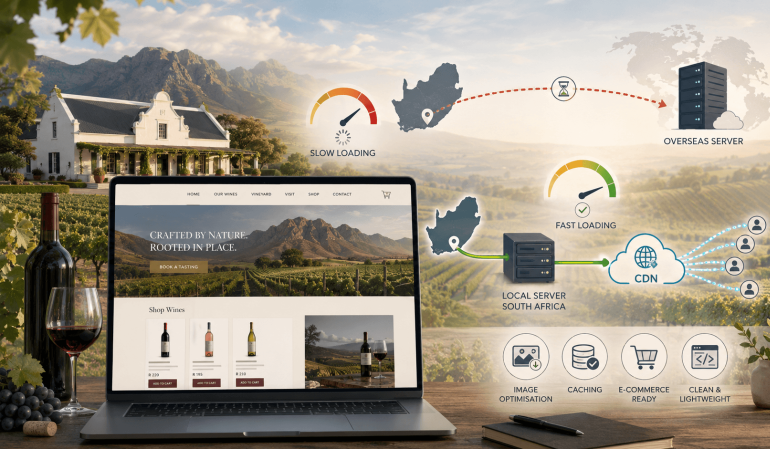
One common reason is that the website is hosted internationally while most visitors are in South Africa. A request from Cape Town, Johannesburg or Durban may need to travel to an overseas server and back before the page can begin loading. The same site may feel reasonably fast in Europe or the United States, while remaining slow for local users.
Test your website locally and internationally
Before making any changes, test your site from both South Africa and overseas. GTmetrix is a useful starting point. Compare results from Johannesburg with locations such as London, Frankfurt or the United States.
Pay attention to load time, Time to First Byte and Largest Contentful Paint. If your South African test is substantially slower than international tests, your hosting location, caching setup or server configuration may be contributing to the problem.
Start with image optimisation
Winery websites are naturally image-heavy. Large vineyard photography, bottle shots and hospitality images can make pages slow, especially on mobile connections.
A simple first step is to run large images through TinyPNG before uploading them. It can significantly reduce file sizes with little visible loss in quality, often improving page speed immediately.
Use fast local hosting for South African visitors
For wineries whose main audience is in South Africa, we recommend considering Namhost. For smaller, low-traffic websites, Namhost’s Free Hosting Package may be sufficient to get started.
Fast local hosting gives South African visitors a better starting point by reducing avoidable network delay. It also provides a stronger foundation for caching, ecommerce and overall website performance.
A hosting migration should not be done blindly. Test the current website first, identify the real bottleneck, and then measure performance again after any change.
Use a CDN when customers are local and international
If your winery serves customers in South Africa as well as abroad, a Content Delivery Network can help. A CDN stores copies of website assets such as images, scripts and stylesheets closer to visitors in different regions.
Cloudflare is the most widely used CDN solution and is often the first option worth considering. A CDN works best alongside good hosting and proper optimisation; it cannot fix a badly configured or overloaded website on its own.
WordPress can become clunky
WordPress can be effective, but many winery websites become unnecessarily heavy over time. Page builders, ecommerce plugins, booking plugins, SEO tools, image tools, mailing-list software, invoice tools and tracking scripts can quickly add complexity.
Plugins are not automatically bad, but each one adds code, database activity, external requests or maintenance overhead. Too many plugins can make a site slower, harder to maintain and more vulnerable to compatibility issues.
Teruza builds clean, Laravel-based winery websites with fewer moving parts and a stronger focus on speed, maintainability and integrated functionality. The performance of Wineries.co.za is an example of the technology and approach Teruza uses.
Keep your shop on the main domain where possible
Where practical, we generally prefer:
yourwinery.com/shop
instead of:
shop.yourwinery.com
A subdomain is not automatically an SEO problem, but keeping the shop within the main website can simplify analytics, internal linking, customer journeys and technical SEO management. A separate shop subdomain should only be used when there is a clear technical reason.
A modern winery website may cost less than expected
A clean, tailored Teruza site can often cost the same as, or less than, a heavily customised WordPress website. As a general guideline, a focused winery website may fall in the region of R20,000, while a tailored website with an integrated shop and payment options may be closer to R30,000.
Teruza can also reduce ongoing software costs by replacing multiple third-party tools. Depending on the project, functions such as mailing lists, invoicing, customer management and ecommerce can be integrated into one platform rather than requiring separate subscriptions.
Get advice before making major changes
Before moving hosting, rebuilding a website or adding a CDN, identify the actual cause of the slowdown.
Teruza can review your website, compare local and international performance, identify technical bottlenecks and recommend the right combination of hosting, optimisation, CDN and technical SEO improvements.
A fast winery website is not just a technical luxury. It affects how long visitors stay, whether they enquire, whether they book, and whether they buy.
Disclosure: This article recommends Namhost and Teruza services. Recommendations should be based on a measured review of each individual website.